
Chemistry
The zeolite group is a large group that includes many well-known and lesser-known minerals. But what exactly makes a zeolite a zeolite? A distinctive characteristic of the minerals that belong to the zeolite group is that they are all quite porous. That may sound a little strange, because the word porous often suggests something with a spongelike structure, something full of tiny holes that easily soaks up water. For zeolites, however, we must look at the crystal structure to understand this porosity. In other words, at the molecular level.
The basis of a zeolite consists of the elements oxygen, silicon and aluminium. These three basic elements form tetrahedra. A tetrahedron is simply explained a pyramid with a triangular base instead of a square one.

It consists of four equilateral triangles. Several of these tetrahedra together form a framework in which they are connected at the corners. There is space between them, and that space can be filled with water or other molecules. This creates a kind of ‘channels’ in the microstructure of the crystal through which these molecules can move freely.
Don’t imagine entire streams of water flowing through your stone, or a landscape full of tiny waterfalls inside it. No, all of this takes place at a microscopic level, we are talking about molecules, not visible flows of water.
History
The story goes that the Swedish mineralogist Cronstedt noticed, when heating zeolite material (possibly stilbite), that steam was released. This was water that had been trapped inside the stone. This observation is what he based the name zeolite on. Zeo- comes from the Greek ζέω, to boil, and -lite from λίθος, lithos, meaning stone.
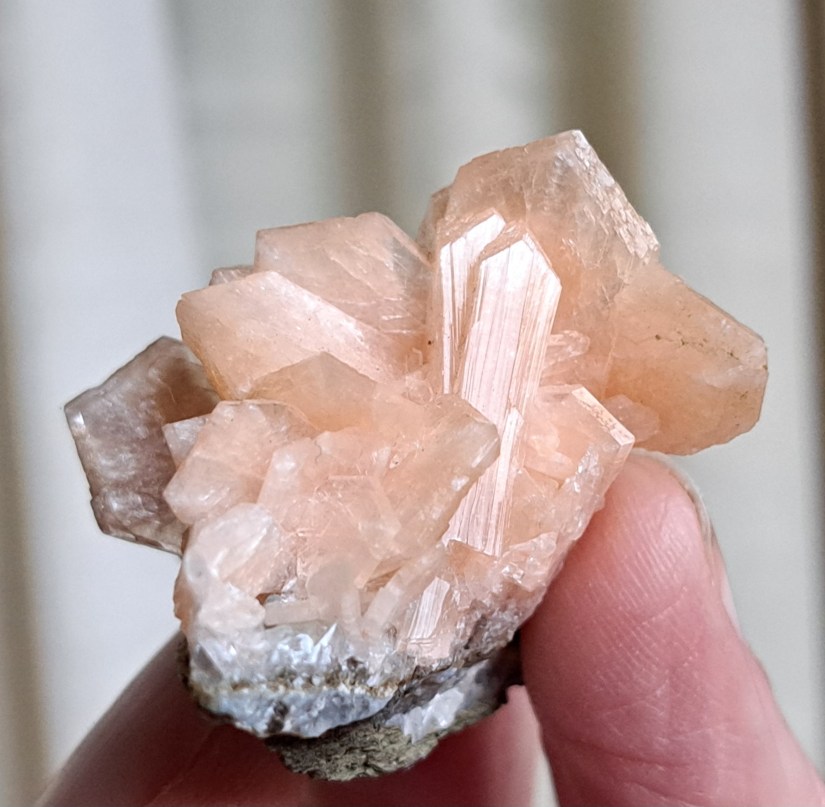
The first zeolites to be described were chabazite, stilbite, harmotome and analcime. Leucite also really belongs in this list but was later removed as a zeolite. There is still some debate about whether it should once again be counted among the zeolites or remain classified as a feldspar substitute.
Nowadays, you often see the mineral name followed by an abbreviation of an element. This is used to distinguish between variations of the same mineral in which a particular element is dominant. For example, stilbite-Ca (stilbite with more calcium) and stilbite-Na (stilbite with more sodium). There is a committee concerned solely with the naming and definitions of zeolites. The problem is that there are several minerals which, strictly speaking, meet the current definition of a zeolite, but are (yet) not included in the classification.
Geology
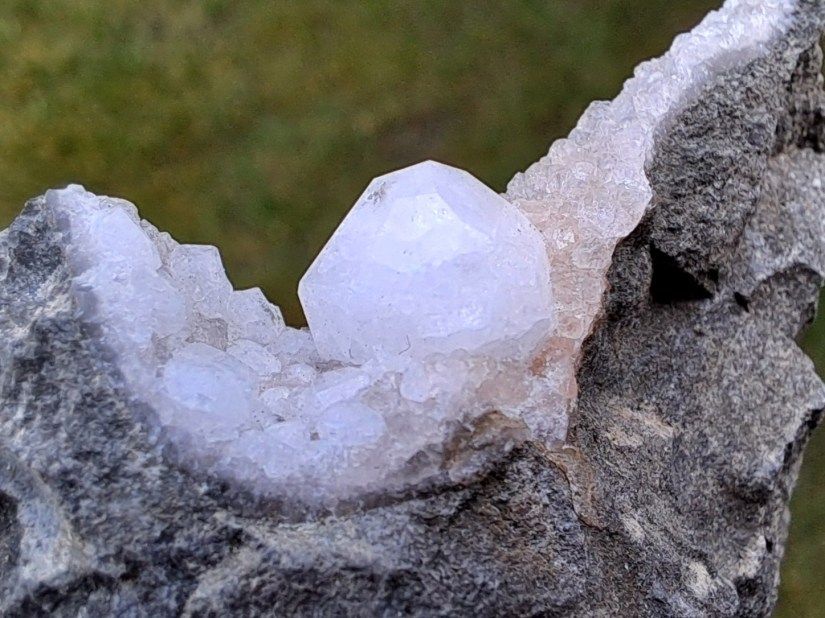
There are an enormous number of zeolites. We know of more than 50 natural zeolites and over 200 synthetic zeolite structures. Well-known zeolite minerals include chabazite, scolecite, thomsonite, analcime, stilbite, heulandite and natrolite. Natural zeolites are found mainly in volcanic rocks, but they also occur in sedimentary rocks.
Zeolites are secondary minerals, meaning that they do not grow directly within volcanic rock but are usually formed after alteration. The only exception may be the mineral analcime, which is thought, in rare cases, to form primarily, that is, directly after solidification of the volcanic rock.

Most zeolites result from the alteration of volcanic glass or, in some cases, from other minerals such as clay minerals, feldspar and certain forms of quartz/silica. Not all zeolites are stable. At high temperatures, they too can transform into other, more stable zeolites.
Zeolites are common in areas where the presence of magma heats the overlying rock, which in turn heats the water seeping through it. These areas are known as geothermal fields. Geothermal means earth heat. Examples of such areas include Iceland, Yellowstone and the Eifel. Because of the heat, water circulates through the rock. This water contains dissolved elements that are deposited in cavities and fractures, where the zeolite minerals then grow. This formation of zeolites is known as hydrothermal. The temperature within the rock largely determines which zeolite minerals can form. Other contributing factors include the composition and porosity of the rock.

Applications
Because of the open framework structure of zeolites, they are very well suited for all kinds of applications in our daily lives. One of their properties is that they can act as a so-called molecular sieve. You know what a sieve does: material finer than the mesh falls through, while larger pieces remain on the sieve. In this way you separate coarse material from fine material, for example sand. A zeolite can do the same, but on a molecular level. Not every atom or molecule is the same size. Atoms and molecules that are smaller than the molecular pores in the zeolite are taken up and allowed through. Atoms and molecules that are too large cannot be taken up by the zeolite and are separated from the smaller ones.
Because the internal structure of natural zeolites is not 100% regular and cylindrical, partly due to impurities in the crystal lattice or pressure on the bonds, synthetic zeolites are preferred for such tasks. As a result, you may find zeolites in cat litter, detergent, nappies, odour absorbers, face cream, toothpaste, cement, solar collectors, asphalt, fertiliser and various types of filters. Zeolites filter water and soften hard water. The Maya already used zeolites to filter water.
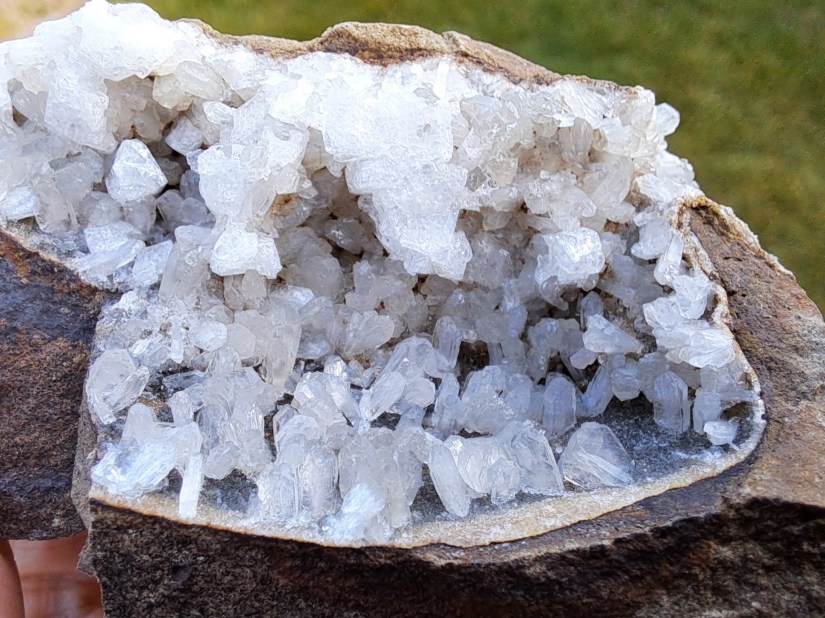
Another very important application of zeolites can be found in oil refineries. Zeolites can help liquids ‘crack’ more quickly, breaking them down into separate substances. This property is extremely useful for turning crude oil into usable and processable products.
Research is even being carried out into the possibilities of using zeolites for the storage of radioactive waste, allowing smaller radioactive particles to be absorbed by the zeolite. When these are treated and compressed, the radioactive waste can be trapped inside an extremely hard block of zeolite. After the Fukushima nuclear disaster in 2011, sacks of zeolite were thrown into the seawater to filter radioactive cesium particles from it.
The scientific community is still very much engaged in exploring the possibilities that zeolites offer. There are countless hypothetical zeolite structures that should theoretically be possible, but which cannot yet be produced physically. Given how useful this material is, people will undoubtedly continue searching for new zeolite structures and for ways to create and apply them. Natural zeolites are of secondary importance compared with synthetic ones. Nevertheless, natural zeolites are mined on a large scale. This mainly concerns clinoptilolite and mordenite, though other zeolites are also commercially interesting, primarily as building materials, such as cement.

The leading countries in natural zeolite production are China, Jordan, Korea, Japan, India and Turkey. Almost all zeolites currently seen on the collector’s market come from the Poona District in India. This is an enormous region composed of basalt, known as the Deccan Traps.
In Europe, zeolites also occur in many places. The best known are the Eifel region in Germany, the Isle of Skye in Scotland, and Iceland.
Today, various sellers offer zeolite “detox” products which claim to cleanse the body. These may involve taking capsules containing clay powder mixed with zeolites. The positive effects of this have not been proven. What has been studied, however, is that such clay can sometimes contain contamination from heavy metals.

Fakes & Frauds
There are various “crafted” zeolites on the market. In these specimens, different zeolites and associated minerals are glued together onto a matrix. These pieces are not always easy to recognise. A UV lamp can help reveal traces of glue.

There are also fake versions of mesolite/thomsonite on the market; these consist of fibreglass balls glued onto a natural matrix.

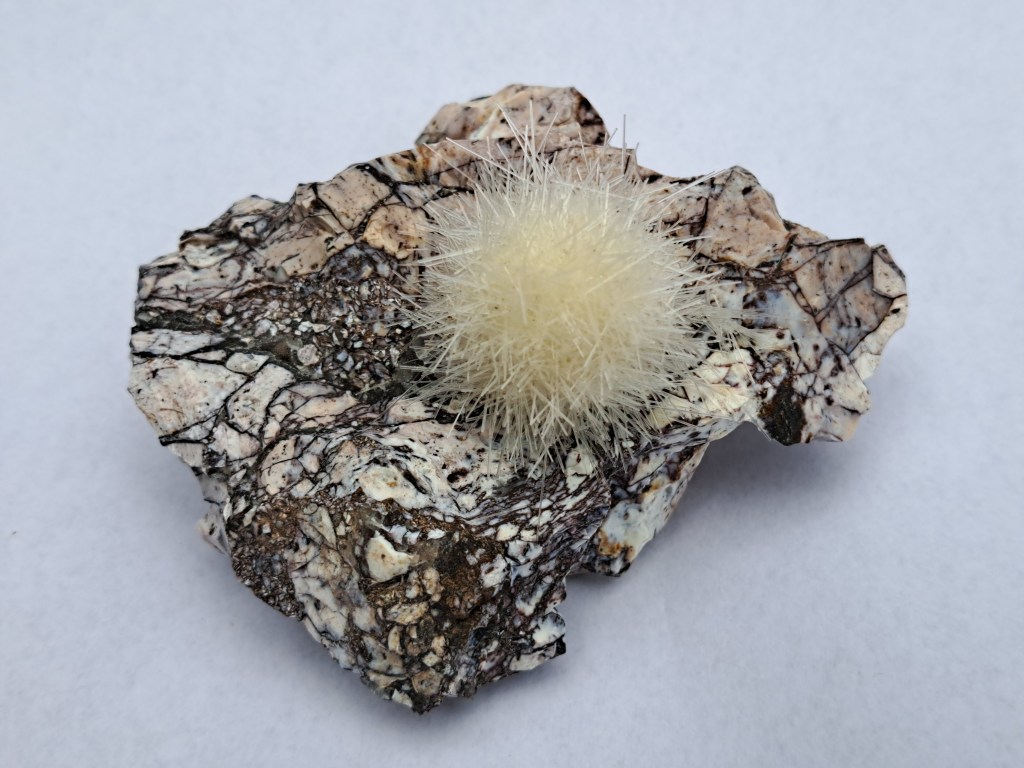
What we often see is that minerals are wrongly labelled as “zeolite”. For example, apophyllite is frequently described as a zeolite. Apophyllite-group minerals often occurs together with zeolite minerals, but they are not a zeolite. We also see, increasingly, pieces of quartz/amethyst with so-called “druzy” or quartz-flower growth being marketed as zeolite. These pieces come from Brazil and are not zeolites.

*Orange-red fluffy spheres like these are often sold as thomsonite with mesolite. However, recent analysis has shown it’s only mesolite.
Sources:
Coombs D.S., Alberti A., Armbruster Th, et al. Recommended nomenclature for zeolite minerals: report of the subcommittee on zeolites of the international mineralogical association, commission on new minerals and mineral names. Can. Mineral. 1997; 35: 1571-1606
Marantos I, Christidis GE, Ulmanu M. Zeolite formation and deposits, 2012
 Puffins and Pies