
The process of producing quartz is older than you might think. In the 19th century it was discovered that by melting quartz under high pressure it could be crystallized again using a ‘seed’ crystal. At that time, people were not yet able to generate sufficient pressure and temperature to grow good quality quartz, but the idea was born.

How do you make quartz?
First, let us look at why we want to make quartz instead of extracting it from nature. There are two good reasons for this. First, natural quartz is not consistent in composition and purity. We always say that rock crystal is the pure and colourless variety of the mineral quartz, but this purity is never 100% pure silicon and oxygen. Colourless quartz contains traces other elements, such as aluminum, iron, chlorine, calcium, fluorine, etc. In manufactured quartz, the purity can be measured and influenced, so all quartz you produce is guaranteed to have the same composition and purity. A second reason is that natural resources are finite and you are dependent on the natural resources and the amount of high-quality quartz. For use in industry, very pure quartz is needed and there is not enough of that in nature to meet the demand.
Synthetic quartz was initially produced for industrial purposes. After people discovered that it has piezoelectric1 properties and oscillates at a fixed frequency when electric charge is applied, many useful applications for quartz were quickly found. It was ideal for use in clocks and watches, and later in sonar, radio and other communication devices. As the applications became more advanced and more numerous, the demand for large quantities of pure quartz increased.
Quartz is produced in an autoclave. This can be compared to a pressure cooker in which pressure and temperature can be increased and controlled. You may be familiar with the autoclave for sterilizing tools used in hospitals. However, an autoclave in which quartz is produced is many times larger and stronger than these autoclaves. Imagine a steel tube of about 120 centimeters in diameter and more than 12 meters high. The walls are almost 30 centimeters thick. There are two compartments in this tube. In the bottom one, natural quartz is melted at a temperature of about 400 degrees (the very high pressure ensures that quartz melts at a lower temperature). In the upper compartment there are racks with so-called ‘seed’ crystals. These are 1 mm thin slices of pre-produced pure quartz. The hot dissolved quartz mixture rises (convection) and thus ends up in the upper compartment. On these seed crystals, new quartz grows from the hot mixture under very high pressure at approximately 350 degrees at a rate of half a mm per day. That sounds slow, but in half a year a perfectly pure crystal is created that is suitable for industrial use. Nature takes many millennia to do this. This way of growing from a warm/hot solution is called ‘hydrothermal’. This entire process is controlled from start to finish and is aimed at obtaining quartz that is as pure and uniform as possible.
The quartz that is used for smelting is natural and is called ‘lascas’. This is divided into 5 ‘grades’ or purities. The highest purity is the clearest, but this is not suitable for use. It contains too much aluminium (or aluminum if you are from the USA). The 2nd and 3rd grades are most used for smelting. This lascas is not very attractive to the eye. They are white opaque solid chunks of quartz and not beautiful crystals. Most lascas come from Madagascar and Brazil.

History
As already mentioned, experiments on how to grow quartz began in the 19th century. The German Karl Emil von Schafthäutl discovered in 1845 that under pressure he could create a quartz crystal from a silica-rich mixture. It took him 8 days to obtain a minuscule crystal. He did not yet have a decent autoclave and his high-pressure device was comparable to a pressure cooker on fire based on the design of the Frenchman Papin. The advantage of working under high pressure is that the same results are obtained at a lower temperature than under normal pressure with a very high temperature. After Schafthäutl’s result, several chemists and mineralogists tried to improve his idea and added various substances to the solution. Not all with the same success. It was not until the beginning of the 20th century that the Italian Giorgio Spezia succeeded in producing a somewhat usable piece of quartz. In the meantime, Pierre Curie and his brother had discovered the piezoelectric property of quartz and it gradually became clear that quartz had very useful properties for new technologies. The best-known application is that of the quartz crystal in a clock. Due to the reliable vibration of quartz, clocks could be kept accurately on time. It was also very suitable for use in communication devices. When the Second World War broke out, the demand for quartz increased exponentially. Germany and the US became leaders in the production of pure synthetic quartz. However, they did manage to produce big enough pieces in large quantities. It was only after the war that they succeeded in doing this on an industrial scale. The largest producers were England, the US, Russia and Japan.
Lab-grown quartz clusters
In recent years, the synthetic production of quartz has also been used to make quartz clusters for the trade/collector market. These synthetic or ‘lab-grown’ clusters are available in all kinds of colours and are unfortunately often offered as ‘natural quartz clusters’. The purple ones are supposed to be amethyst, the yellow ones citrine, the green ones chlorite or phantom quartz. They even come in pink and blue. The production process of these clusters is partly comparable to the industrial quartz described above, but there are also a few differences. The base of such a cluster is not a wafer-thin quartz plate. The base is made by mixing a kind of white cement with small quartz fragments. Natural quartz crystals are placed in this mixture. Then the whole thing is placed in an autoclave with quartz/lascas dissolved in an alkaline solution and a synthetic quartz layer grows around the natural points.


Research into these quartz clusters shows that many characteristics of synthetic quartz correspond to natural quartz. Think of hardness, refraction and density/specific gravity. However, there are also a few differences. Because natural quartz grows in an uncontrolled environment and is exposed to various conditions and influences during growth, the outer layer of natural quartz is somewhat porous. You cannot see this with the naked eye. But if you were to look with a microscope, you would see enclosed impurities, negative quartz growth and bubbles. This is considerably less with synthetic quartz. Unfortunately, this is of little use to you as a layman, because we have to make do with characteristics that we can see with our naked eye.

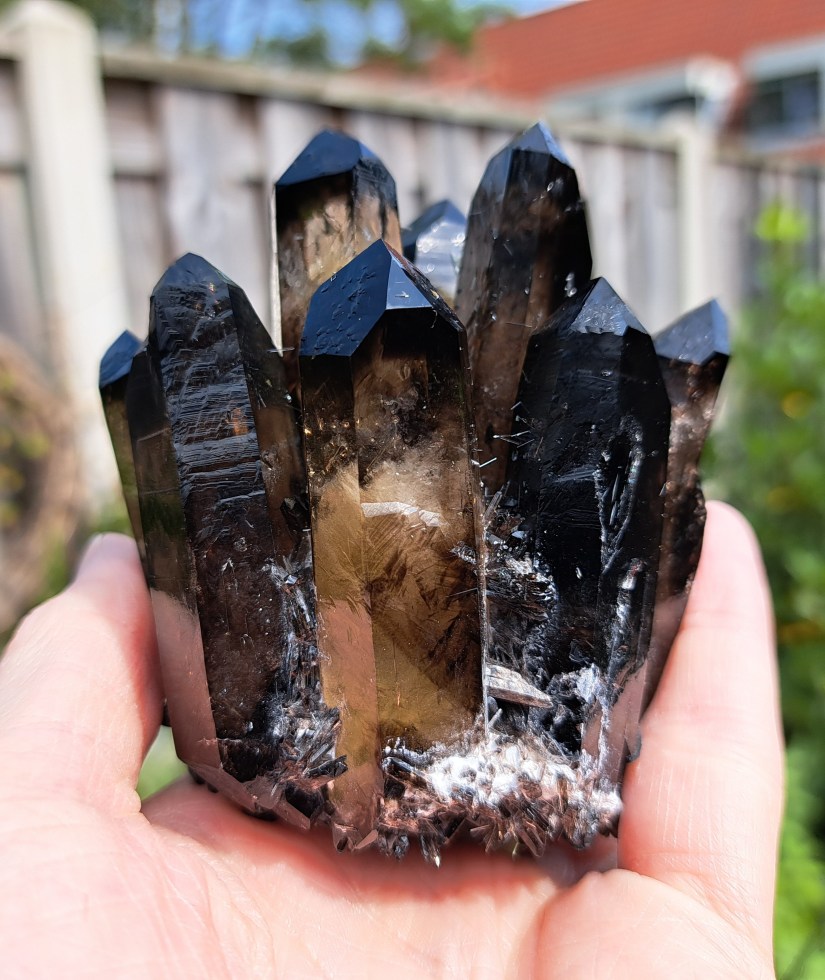
Fortunately, there are a few things that we can recognize this lab-grown quartz by. The recent Chinese clusters are quite uniform in appearance. They have a white cement base from which several large points ‘grow’ radially. This cement base and the (bottom of) the points are overgrown with hundreds of tiny razor-sharp crystals. The crystals themselves look a bit messy on the surfaces, they do not have the neat striation (horizontal lines) that a natural quartz point has. On a lab-grown point this striation is messy or absent. If you tap it with your fingernail, it sounds different from natural quartz, more glass-like.
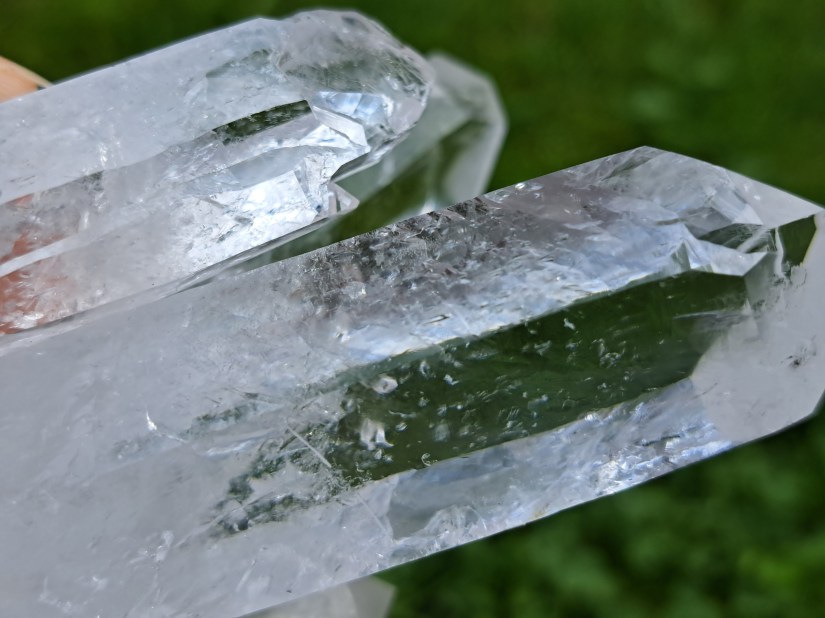

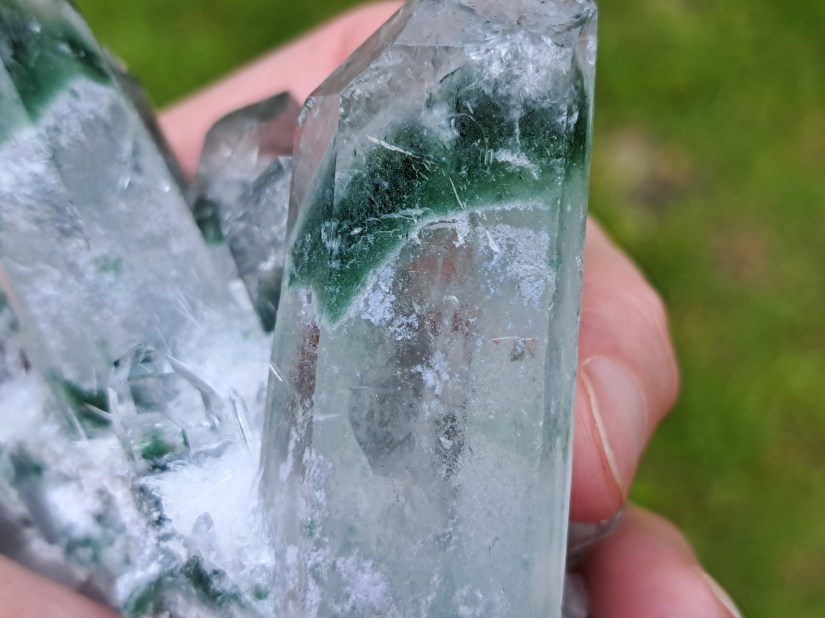
The colours are, apart from the colourless variant, unnatural and sometimes show very dark phantoms that often do not follow the growth pattern of the crystal as with natural phantoms. The clusters usually do not have a matrix (mother rock) on the bottom. That said, there is now also a variant where the crystals have grown on a piece of natural rock.
This description only applies to the clusters that have recently come onto the market from China. There is also older (Russian) synthetic quartz in clusters. This is often purple and passes for amethyst. This lab-grown quartz is a lot harder to distinguish from real. Fortunately, it is relatively rare in trade and the prices are quite high.
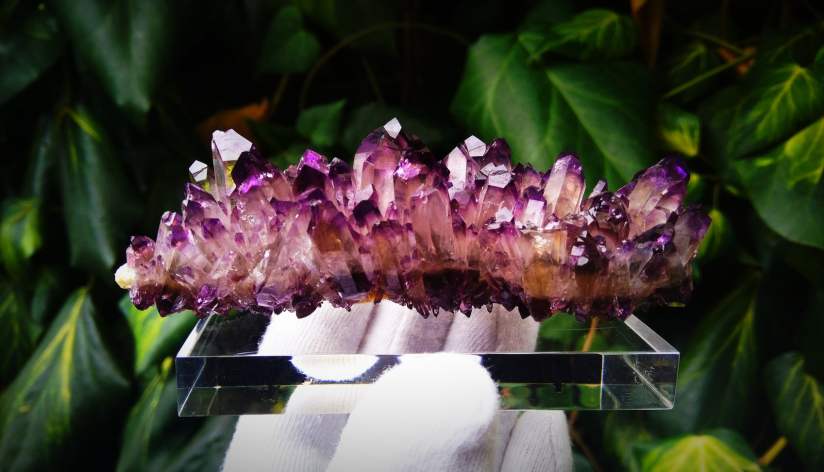
In addition to industry, it was inevitable that jewelers and cutters discovered this quartz and started using it as a replacement for natural quartz. By adding certain elements such as manganese and iron, the quartz could be coloured and passed off as citrine or amethyst, and later even ametrine. This synthetic quartz, once cut, is difficult to distinguish from the real thing. This can only be done with specialist equipment.


1 Piezoelectricity: This is created by the crystals producing an electrical voltage when they are put under pressure and bend. As a result, both ends of the stone are under a different charge, just like a magnet. This also works the other way around, a piezoelectric crystal that is put under voltage will bend slightly. The latter is how quartz is usually used in, among other things, watches, when it is put under voltage it oscillates exactly 32.768 times per second. In addition to quartz, tourmaline and topaz share this property.
Sources:
https://www.rockngem.com/how-is-synthetic-quartz-made/
https://web.archive.org/web/20180417133727id_/http://www.minersoc.org:80/pages/Archive-MM/Volume_29/29-217-858.pdf
Historical review of quartz crystal growth. F. Iwasaki, H. Iwasaki. April 2002
Journal of Crystal Growth 237
ndk.com
 Puffins and Pies