
There are a lot of stories surrounding shungite. If you do a quick search on the internet and read what shungite is supposed to be good for, you start wonderingwhether we shouldn’t just give everyone a load of shungite and fire all doctors. It works, if you can believe the promises, for just about everything. From viruses to cancer and from infections to most pains. That is why we are going to look at a number of these stories and to what extent these are facts or we can relegate them to the fairy tale realm.
Shungite was first described in Russia, but is now found in more places, including India, Madagascar and Congo. It is also called pyrobitumen. It consists largely of carbon.
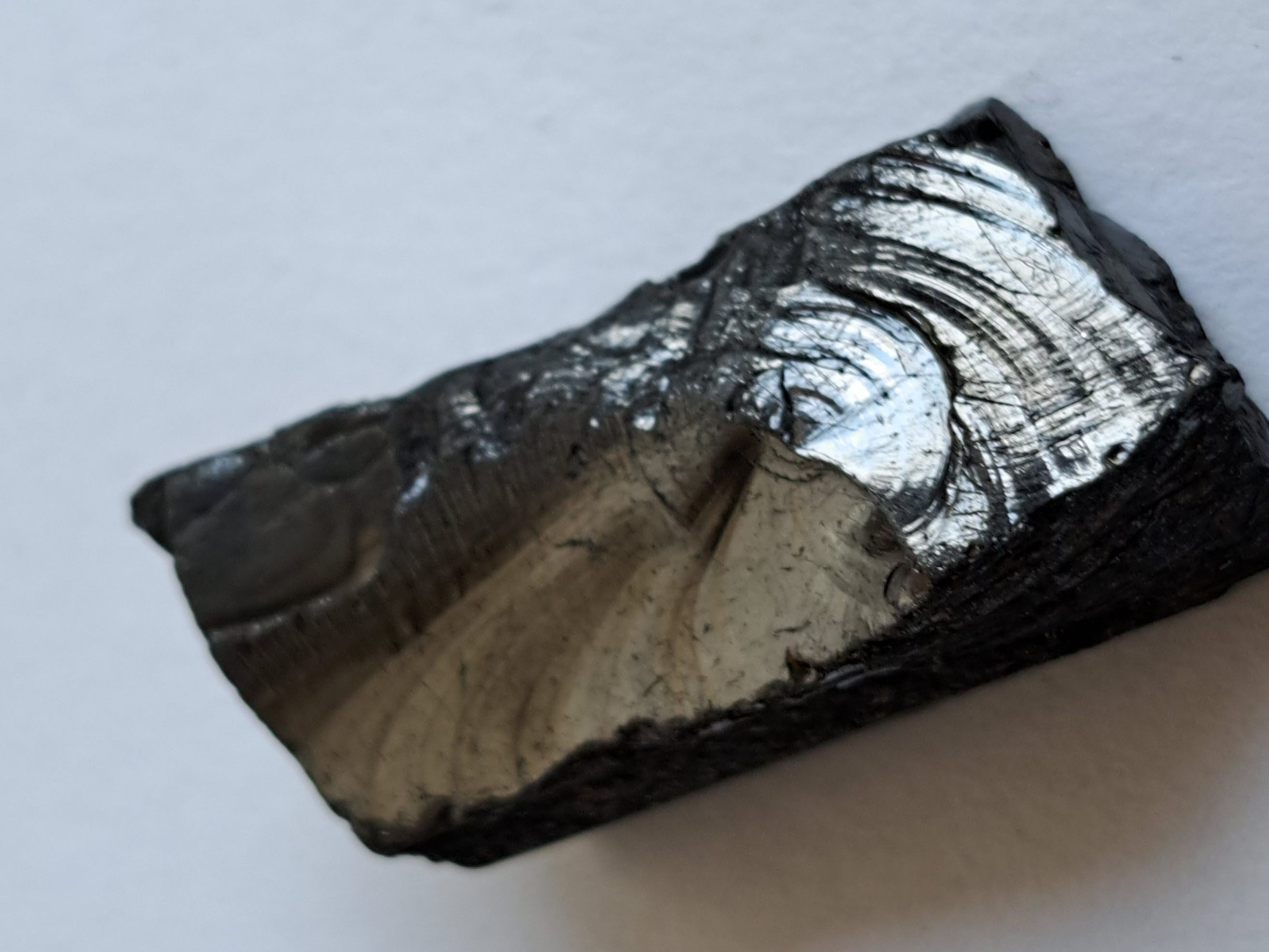
1: Shungite has an extraterrestrial origin. Fact or fiction?
Shungite was deposited in water, low brackish water, a kind of lagoons, in an area with many active volcanoes. The volcanic material provided the right conditions and substances (food) in the water, so there was a lot of biological activity, let’s call it life, in the water and a lot of carbon was deposited. Imagine this life as single-celled organisms. In fact, shungite is formed by microscopic organisms seawater. Initially, this formed oil-containing shales, this is in fact the oldest known deposit of oil in earth’s history. But due to high pressure and heat, this oil shale changed into shungite. If you heat good quality shungite, it will not melt or burn, but it will give off a kind of tar-oil-like smell. It is sometimes claimed that shungite was formed by a meteorite impact and therefore contains extraterrestrial material. This theory has now been well-substantiated by science and is incorrect.
2: Shungite purifies your drinking water. Fact or fiction?
In its pure form, shungite consists largely of carbon. We know carbon from its use in water filters. It filters and purifies. People have known this for a long time. Tsar Peter the Great had a spa in Karelia, the most important shungite area, and knew about the purifying effect of shungite on the water. He gave his soldiers pieces of shungite so that they had pure water wherever they were. Modern science has proven that carbon purifies water from harmful bacteria. But… originally, the name shungite only applied to the very pure form with only carbon. But there are also rocks with a lower carbon content that are now sold as shungite.
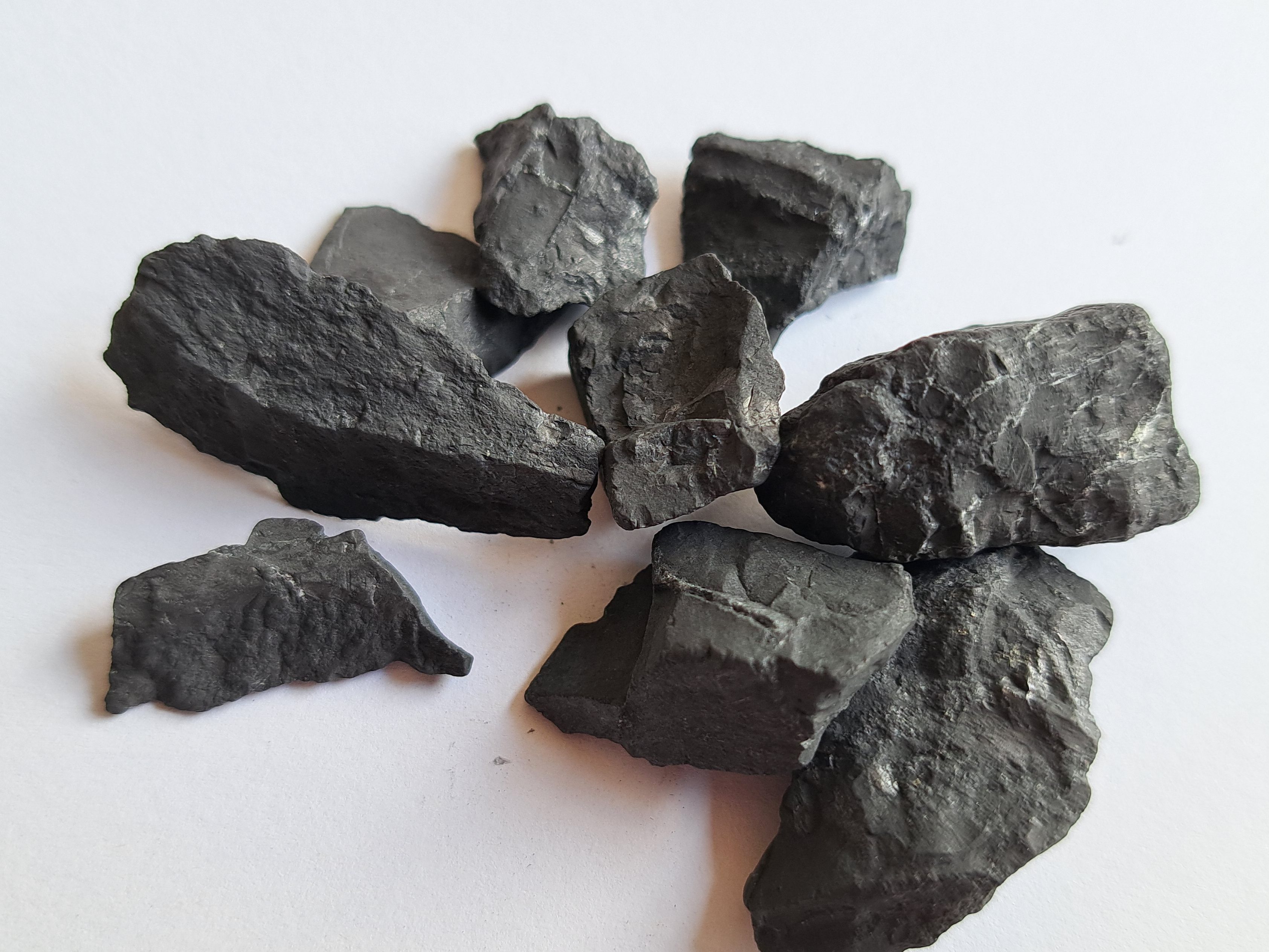
A subdivision is made into Shungite grades 1 to 5, where 5 contains less than 10% carbon (but can still be called shungite) and 1 contains between 98-100% carbon. This pure form is rare and it is estimated that only 1% of all shungite is this pure. Other elements that are present in the impure forms include silicon, titanium, aluminum, iron, potassium, manganese, vanadium, copper, nickel, chromium, and arsenic. Much of the shungite that is sold as waterpurifier is the non-glossy, matte variety. This often also rubs off on your hands. Then you know that you are dealing with an impure shungite variety that can contain the other elements just mentioned in addition to carbon. You don’t want to ingest too much of the last few in the list! Fortunately, there is not much of it in it, but it is still good to think about it before you put this in your drinking water.
Fact: Carbon powder filters your water. Myth: Shungite powder in water is good for you. Myth: A small piece of shungite can purify water.
3: Shungite is good for you because it consists of fullerenes. Fact or fiction?
Shungite is often said to contain fullerenes. What are these actually? Fullerenes are spherical structures of carbon atoms. They can take on a spherical or elliptical shape. The spherical shape looks a bit like a football with pentagons and hexagons of carbon that together form a ball. This construction is very stable. Fullerenes are thought to have certain positive applications in the medical field. However, research into this is still in full swing. The claim that shungite contains fullerenes and is therefore beneficial is often made. However, shungite is not made up of fullerenes, but of atomic compounds that resemble fullerenes (but are not real fullerenes). Shungite does contain real fullerenes, but the proven quantities of these are between 0.0001 and 0.001%, so very little. Some people claim that fullerenes have an extraterrestrial origin. They have indeed been found at places where meteorites have struck. We just don’t know for sure about all of those places. And this does not concern the fullerene type present in shungite. We also know fullerenes can form during very strong lightning strikes, because they have also been found in some fulgurites. So they have also been found in places that cannot be linked to meteorite impacts.
Fact: shungite contains fullerenes (but only a tiny percentage). Myth: it is therefore good for your body.
4: Shungite helps to cure cancer. Fact or myth?
To get straight to the point, this is complete and utter nonsense! The statement is based on research into the aforementioned fullerenes. Science is investigating possible applications of these for certain types of cancer. And the results are promising. But this concerns synthetic fullerenes that are used in controlled doses. That cannot in any way be compared to those 0.0001 – 0.001% fullerenes in a piece of stone. Even if you grind the whole stone and eat it, there is still no reason to assume that the one fullerene you might ingest can break free from the powder and bind to a cancer cell. Let alone that a shungite stone outside your body can do anything about this.
Other studies focus on the antioxidant effect of shungite. A test showed that pure shungite has a slight antioxidant effect (it binds free radicals, substances that are harmful to us). The effect of shungite is compared to 3 known antioxidants, namely vitamin C, E and quercetin. The effect of shungite is considerably lower than all these substances that are simply in our food. It works 1000x less than quercetin. Eating a bowl of grapes or broccoli and an apple therefore has more effect than putting shungite in water and drinking it. Suggesting these things and promising that shungite does something against cancer or any other medical condition is a myth and it is prohibited by law.
5: Shungite protects against electromagnetic radiation.
Yes, that’s correct. Science is doing a lot of research into this application of shungite and it can indeed block this type of radiation. But… This only works if you place a large shungite barrier between you and the source of the radiation. In other words, you have to sit behind a man-high wall of shungite that is in front of your computer or microwave. Or in a box with shungite walls. And that would be a bit difficult. A stone next to your computer or against your telephone does absolutely nothing. Because the radiation can simply go around it. And even then, not all radiation is blocked. I will not venture into the discussion about whether or not this radiation is even dangerous.
Be careful! Nowadays there are so-called 5G anti-radiation pendants that are sometimes claimed to be made of shungite. These pendants even made the news because they turned out to be quite radioactive. They have nothing to do with shungite at all and are dangerous to use.
Another study was done on the claim that shungite would protect against certain forms of UV radiation. In this study, bald mice were smeared with shungite-containing oil and then exposed to radiation. It was found that the mice that were using the shungite-containing oil did indeed suffer slightly less damage from the radiation. Unfortunately, this test was not very animal-friendly and all mice were gassed after the test. So even in the mineral world, things are not always free of animal testing.
Fact: Shungite can somewhat block electromagnetic radiation or UV radiation. Myth: a single shungite stone protects you against radiation.
6: Shungite is 2 billion years old.
Russian shungite is indeed very old, up to 2 billion years old. However, most deposits are a lot younger, around 600 million years old. This claim is therefore correct in some cases when it comes to Russian shungite.
Time for a conclusion
Many of the claims that are made have their roots in science somewhere, far away. However, this scientific basis has been so strongly taken out of context, stripped down and placed in the wrong frameworks and perspectives that in most cases they are misleading and untrue. A shungite stone on a necklace is really not the same as the tested and purified material used during research. So remain very critical of all promises surrounding this stone, which despite the fact that much of what is said is incorrect, has a very fascinating geological history.
 Puffins and Pies