Prasiolite is a green variety of quartz whose colour results from trace amounts of iron within the crystal structure. These iron atoms are incorporated into, or occupy positions between, the quartz lattice during crystal growth. Subsequent exposure to natural radiation alters the iron-related colour centres, producing the characteristic green hue.
There are only a few places in the world where natural prasiolite is found. The best known are Silesia (Poland), Montezuma (Brazil), Farm Rooisand (Namibia) and Thunder Bay (Canada).
However, most prasiolite available on the market is not naturally occurring green quartz, but heat-treated amethyst. Amethyst and prasiolite share the same basic chemical composition (SiO₂), and both owe their colour to trace amounts of iron within the crystal lattice. They commonly occur together in the same geological settings.
The heat treatment of amethyst is well known from the production of so-called “heat treated amethyst”, sold as citrine. Under controlled heating, the iron-related colour centres responsible for the purple colour are altered. At relatively higher temperatures this typically produces yellow to orange hues, whereas at lower temperatures certain amethyst material can develop a green colour instead, resulting in prasiolite.
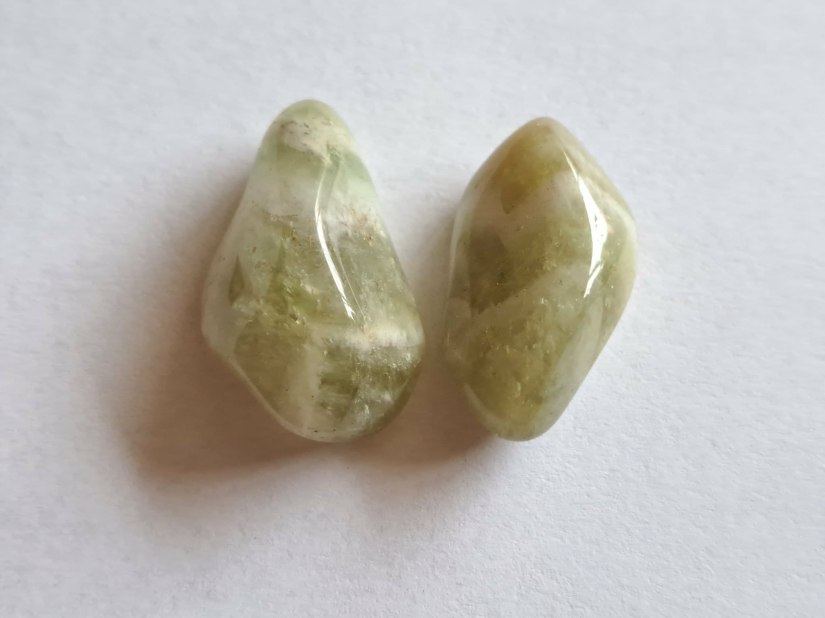
Natural prasiolite is typically very pale green, as seen in material reported from Brazil and Thunder Bay (Canada), or brownish green to nearly brown, as described from Poland. Confirmed natural occurrences are extremely rare, and such material is only infrequently offered commercially.
It is therefore reasonable to assume that the vast majority of prasiolite available in shops, including faceted stones, consists of heat-treated amethyst rather than naturally green quartz.
Tumbled stones sold as “prasiolite” may sometimes display the characteristic banding of chevron amethyst. This banding indicates that the material was originally chevron amethyst and subsequently heat-treated; it is not natural prasiolite.
The material marketed as “amegreen”, showing both green and purple zones within the same stone, is likewise the result of artificial heating. The green portions derive from heat-altered amethyst rather than from naturally occurring prasiolite.
Prasiolite is sometimes marketed under the name “green amethyst”. Although the term may appear understandable, since both amethyst and prasiolite derive their colour from iron and may, in rare instances, occur in association, it is nevertheless incorrect and potentially misleading.
By definition, amethyst is the purple, macrocrystalline variety of quartz. A green variety of quartz, therefore, cannot properly be termed amethyst. Most natural prasiolite has never been amethyst, and conversely, the vast majority of material sold commercially as “green amethyst” is not natural prasiolite.
The designation “green amethyst” is commonly applied in two situations. In some cases, the green appearance is caused by a green host matrix or by included minerals, meaning the material is not amethyst at all. In other cases, the term refers to heat-treated amethyst that has been altered to produce a green colour, i.e. artificially produced prasiolite. In the first instance, it is not amethyst; in the second, it is not natural. In both cases, the name is mineralogically incorrect.
 Puffins and Pies