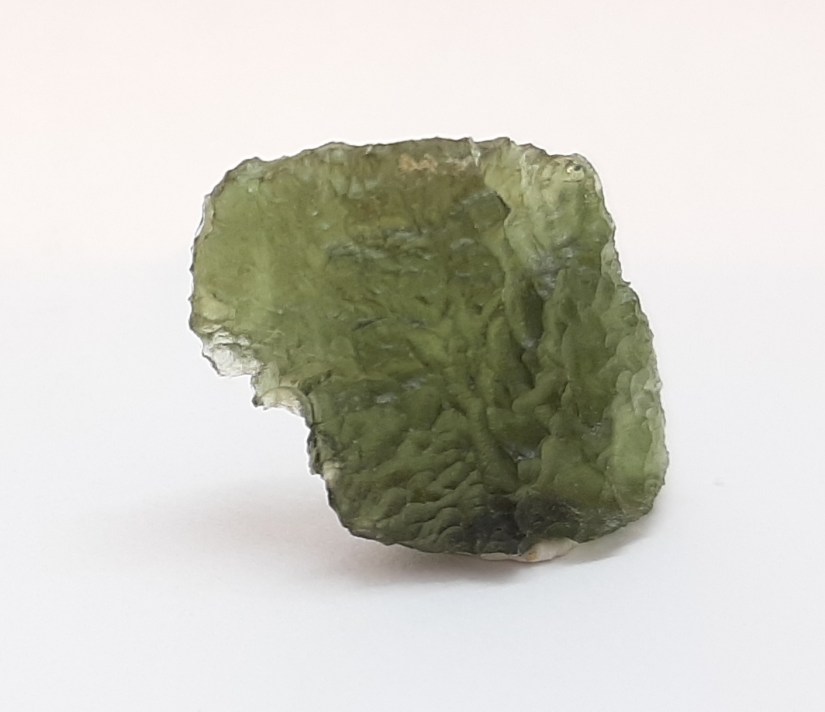
Moldavite is a beautiful green tektite found in only one region: the southern part of the Czech Republic, with small adjacent areas in Austria and Germany. The meteorite impact that led to the formation of moldavite occurred just north-west of present-day Munich. The resulting crater is known as the Ries crater.

A tektite is a natural impact glass formed by the collision of a meteorite with the Earth. Tektites are not particularly rare and occur in various locations around the world. What distinguishes moldavite is its striking green colour (although brown varieties also exist). This colour is caused by the presence of iron. The lower the iron content, the lighter the green; higher levels result in a more brownish-green hue. The oxidation state of the iron also influences the colour: divalent iron produces a greener tone, while trivalent iron gives a browner shade.

Moldavite has been known for a long time, but until relatively recently it was not recognised as a tektite. The green glass fragments were probably regarded as special even in prehistoric times. For centuries, their origin remained a mystery, and numerous theories were proposed, ranging from volcanic glass to remnants of ancient glassworks. In 1786, moldavite was first formally described by Professor Joseph Mayer, who referred to it as chrysolite. It was not until the 1960s that the Ries crater was identified. The composition and age of the moldavite matched those of the subsoil in the Ries area, leading to the conclusion that the two were directly connected.
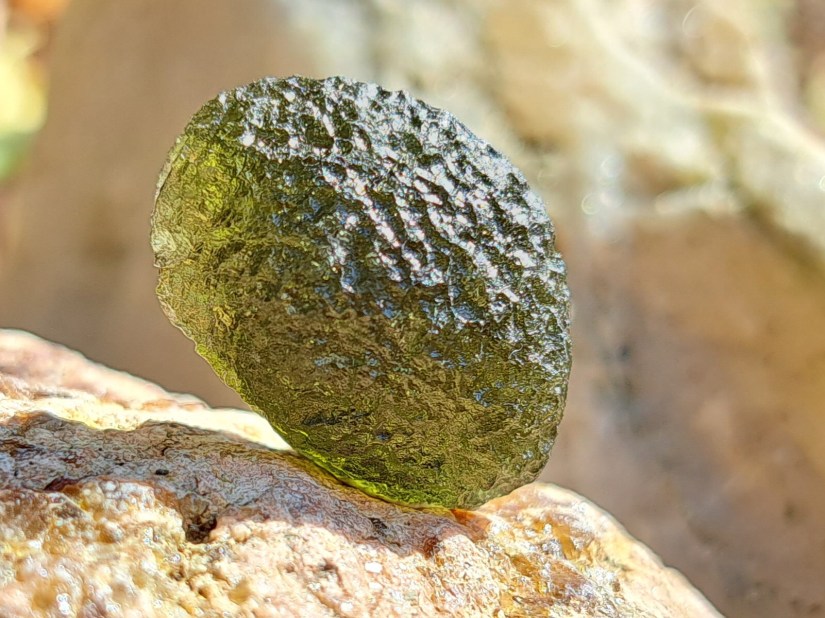
Moldavite is named after the Moldau (Vltava) River, near which most specimens are found. The south-west of the Czech Republic is the best-known source area, but moldavite also occurs just across the Austrian border in the Waldviertel region and in a small part of eastern Germany (Lausitz). This is quite a distance from the impact site. The entire region in which moldavite is found is known as the strewn field. During the impact, vast quantities of material were ejected into the atmosphere under extreme pressure and temperature. The material melted and then cooled and solidified rapidly, forming glass.
Moldavite has a Mohs hardness of 5.5–6. Under a microscope, elongated, worm-like streaks known as lechatelierite inclusions can be observed. Moldavite also displays so-called ‘schlieren’, straight, fine lines characteristic of genuine specimens. These formed because the material remained molten for only a very short time. They are thought to represent grains of sand that did not fully dissolve and mix within the melt.

The characteristic sculpted surface of moldavite is not directly related to its initial formation; it developed later through natural chemical etching by acids in the soil. Air bubbles are a common feature. These are often somewhat elongated, although round bubbles do occur. A distinction is sometimes made between larger isolated bubbles and smaller ones that frequently occur near the lechatelierite (chemically amorphous SiO₂) inclusions.
Compared with other tektites, moldavite has a relatively high silicon dioxide (SiO₂) content. Owing to the low proportions of titanium dioxide and iron oxide, many pieces are reasonably transparent. The composition of moldavite glass is generally attributed to sediments of the ‘Obere Süßwasser Molasse’, freshwater deposits that covered the area at the time of impact. These consisted mainly of quartz-bearing sand, very little carbonate material and abundant plant matter. Although the compositional match between the deposits and moldavite is not exact, it is sufficiently close to support this conclusion.
It is widely accepted that the material from which moldavite formed is primarily of terrestrial origin. It is therefore not considered to be a significant mixture of terrestrial and extraterrestrial material. Trace elements likely derived from the meteorite are present, but only in extremely small quantities, amounting to fractions of a percent.

The air bubbles in moldavite are a subject of study in their own right. Analyses have shown that they consist largely of carbon monoxide, along with nitrogen, hydrogen, carbon dioxide and hydrogen chloride. The overall carbon content of moldavite is very low, and the carbon present is believed to be of organic origin, probably derived from plants growing in the impact area. The presence of these bubbles suggests that the glass formed in an environment with very low air pressure, likely high in the atmosphere. Although the pressure within the bubbles is also very low, this does not necessarily reflect atmospheric pressure at the time of formation.
Three main theories have been proposed to explain the formation of air bubbles in tektites. The most widely accepted theory suggests that the exterior of the molten glass cooled more rapidly than the interior. As the interior cooled, it contracted, occupying less volume than when molten. This contraction created voids within the glass, forming bubbles that are nearly vacuum-filled. A second theory proposes that gases already dissolved in the molten material were released during rapid cooling and became trapped as bubbles. A third hypothesis, that gases from the surrounding environment became enclosed in the glass, has been investigated, but appears to be a very rare process.

At first glance, moldavite appears highly variable in shape. However, most specimens belong to the so-called ‘splash-form’ type of tektite. These shapes developed during flight through the atmosphere and include droplets, bell shapes, spheres, ellipsoids and elongated forms. Some shapes resulted from rotation during flight. Undamaged, complete splash-form specimens are rare and highly sought after, and therefore expensive. The well-known ‘hedgehogs’ from the Besednice area are among the most valuable and desirable moldavites. Although their appearance resembles a splashed droplet, this form developed later through prolonged weathering. A second, much rarer type found among moldavites is the layered Muong Nong-type tektite.
Because moldavite occurs in such a limited geographical area and is no longer being formed, it is considered relatively rare. In recent years, its popularity has increased significantly, partly due to social media. As a result, both demand and prices have risen. Ordinary pieces are generally priced by weight, per gram or carat. Exceptional shapes, such as complete droplets or other distinctive splash-form specimens, can command considerably higher prices. The most sought-after and expensive are the ‘hedgehog’ forms, with some specimens offered for sale for thousands of pounds or dollars.
Fakes & frauds
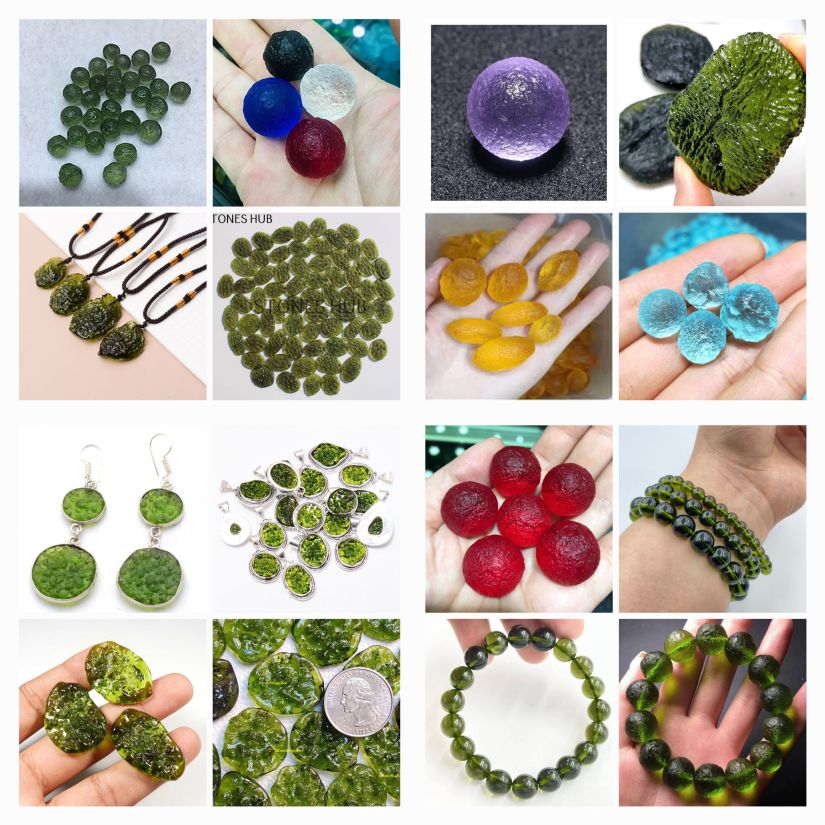
Unfortunately, due to the social media hype surrounding moldavite, the supply of fake pieces has increased significantly. Most imitation moldavite is simply man-made green glass. Fortunately, there are several things you can look out for when purchasing a piece:
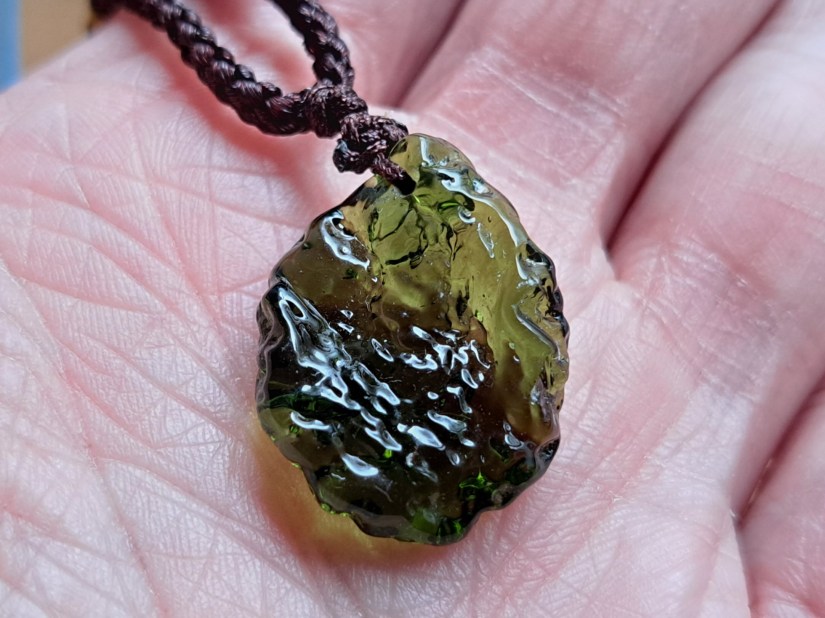
– Raw moldavite has a matte sheen. If you see a rough piece with a high lustre, a glassy sheen or a greasy appearance, you may assume it is fake.
– Every rough piece is unique. If all the pieces offered by a dealer look identical or have the same shape, this is highly suspicious. Many fake pendants are flat and round, about the size of a euro coin.
– Genuine moldavite is not cheap. This is not a guarantee that expensive pieces are real, but very cheap pieces are certainly a red flag.
– The surface structure is sometimes milled by machine. This can be recognised by rougher areas within the grooves, straighter lines and abrupt transitions. This is one of the most difficult types of fake to identify, as the artificial grooves can be lightly etched with acid to make them appear more natural.
– Under a microscope, genuine moldavite displays the characteristic worm-shaped inclusions and sometimes a small number of (slightly elongated) bubbles. These are more difficult to replicate in inexpensive imitations.
– A large number of round air bubbles within a piece is suspicious.
– For polished pieces, the refractive index of moldavite differs from that of ordinary glass. A refractometer can therefore be used to determine whether a piece is genuine.
– Moldavite is green and only very rarely brown or brownish-green. Large pieces can seem dark, but when you shine a light through they should still be green. Other colours are fake. Nowadays, red, blue, yellow and rainbow-coloured “moldavite” are offered for sale — these are all imitations.
– If a seller claims that a piece originates from a location outside the known strewn field, it is very unlikely to be genuine. On rare occasions, pieces have been found outside the documented areas, but this can usually be traced to movement by water, and very occasionally by people (for example, pieces discovered during archaeological excavations of prehistoric sites). But these sites are not in China, Australia, Madagascar or India.
– Regarding “moldavite” bead bracelets: consider this carefully. Most moldavite pieces are not thick enough to carve into beads. Round beads would have to be made from large, and therefore more expensive, pieces. If such a bracelet is offered for only a few euros, dollars or pounds, it is almost certainly too good to be true.
– A “certificate of authenticity” is, unfortunately, no guarantee of authenticity. Anyone can produce a fake certificate. There are many meaningless certificates in circulation, sometimes bearing forged test numbers supposedly issued by gemmological laboratories. This applies not only to moldavite, but to many other polished and unpolished stones as well.
All images shown here are fake ‘moldavite’ pieces


 Puffins and Pies