Larimar is a beautiful blue variety of pectolite that is found only in the Dominican Republic (Sierra de Baoruco, Barahona Province). This particular variety does not occur anywhere else in the world.
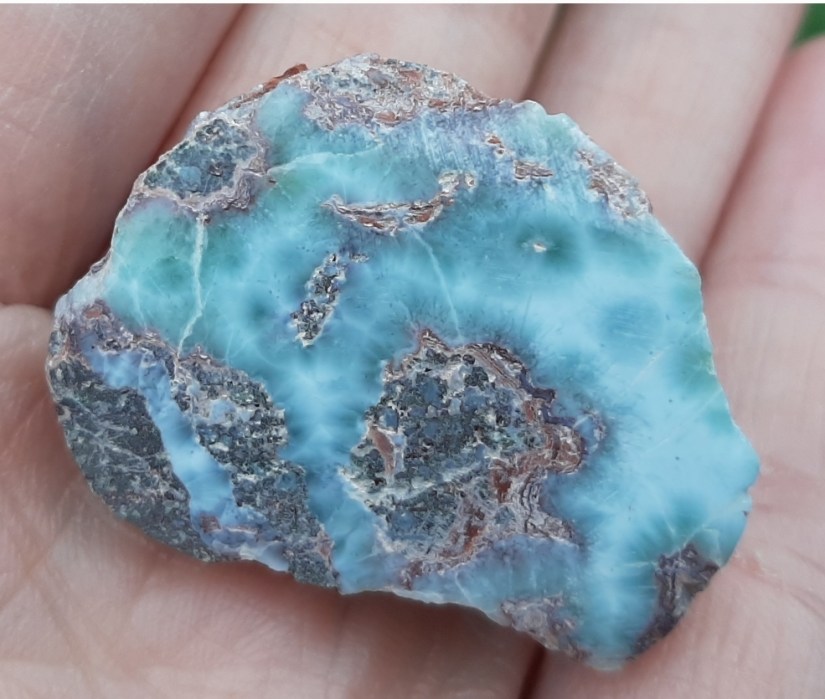
Pectolite is a sodium–calcium silicate (NaCa₂Si₃O₈(OH)). It contains, among other elements, sodium, calcium, silicon and oxygen. Pectolite is usually greyish white or pink, but the larimar variety is a beautiful blue. It is not particularly hard, with a hardness of about 4.5–5 on the Mohs scale. Larimar is sometimes treated to make it easier to cut and polish; in such cases, the original hardness can no longer be determined.
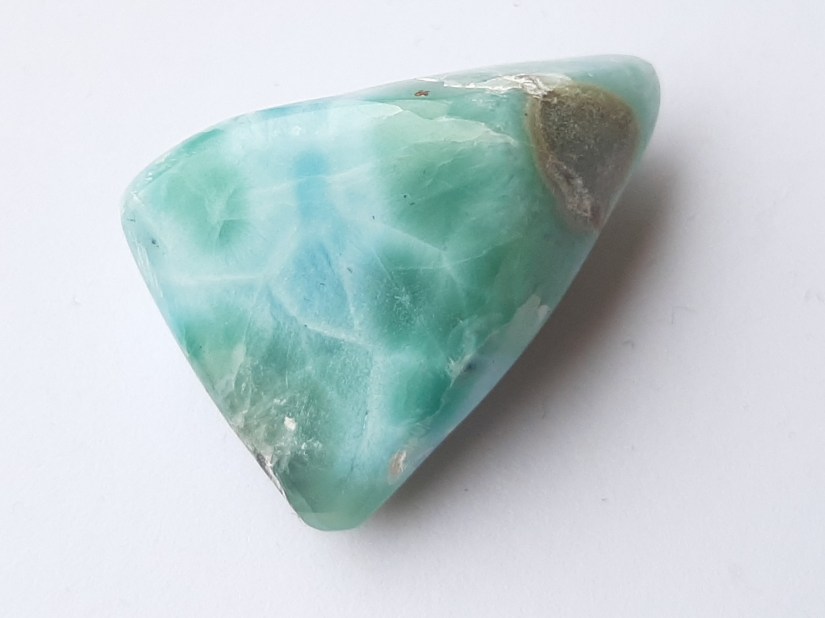
Larimar was discovered in 1916 by a Spanish priest. It is found in layers of volcanic rock containing basalt and tuff dating from the Cretaceous and Eocene periods. Larimar forms in hydrothermal veins within basaltic volcanic rocks. These veins developed when hot, mineral-rich fluids circulated through fractures in the volcanic host rock. Its formation is linked to tectonic uplift and faulting in the Caribbean plate boundary zone, which allowed fluids to move and minerals to precipitate. The surrounding rocks may also contain chalcedony, natrolite, hematite, calcite, apatite, sphene, datolite and prehnite. The colour of larimar ranges from almost blue-white to intense sea blue and blue-green. The exact cause of the colour is still not fully understood. Current scientific consensus suggests the blue colour is caused by trace-element substitution (most likely Cu²⁺, possibly combined with Mn or V) replacing calcium in the crystal lattice.The precise mechanism is still debated because the colour appears patchy and zoned, suggesting fluctuating chemical conditions during growth. Copper is present only in low concentrations.
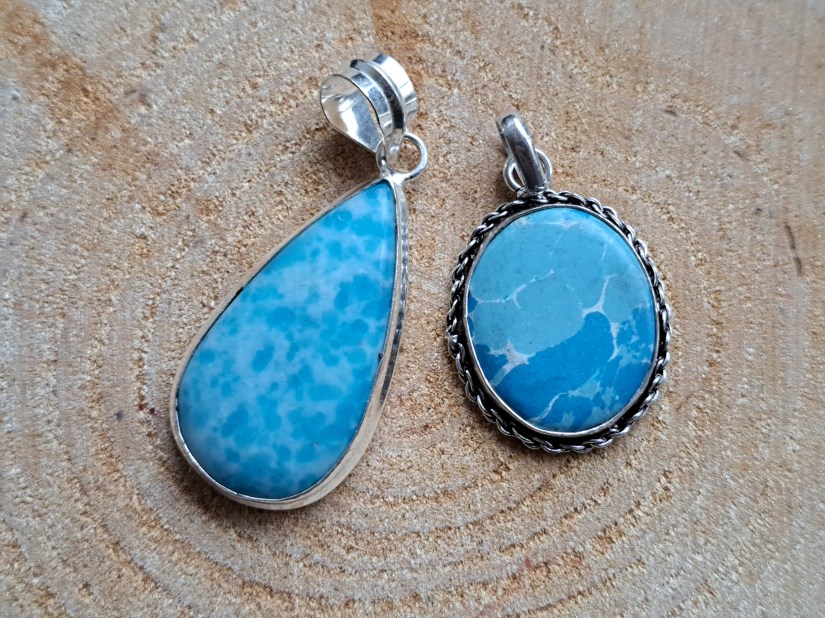
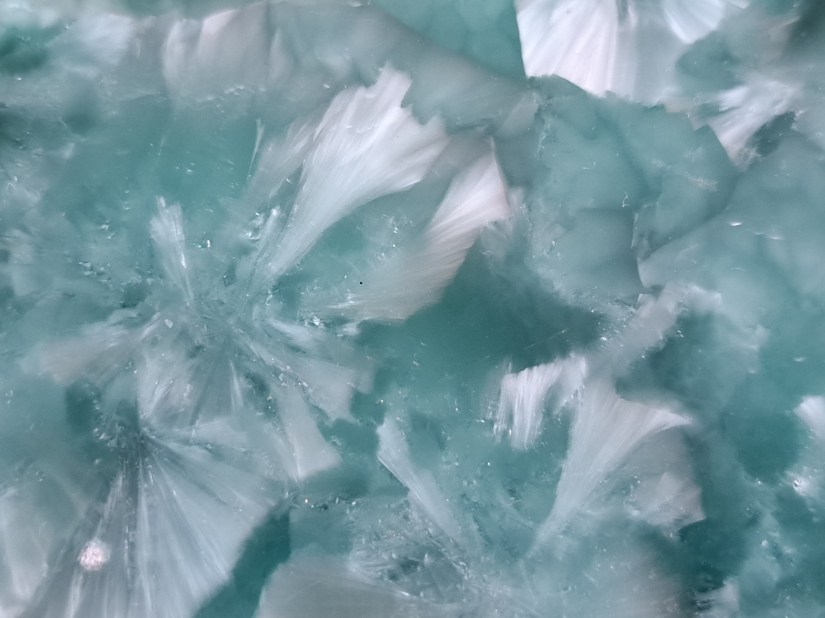
Because of its popularity and high prices, imitation varieties are increasingly appearing on the market. Blue hemimorphite and aragonite, as well as the man-made “Victoria Stone” (often referred to as Chinese larimar), are well-known substitutes. Clay pendants and dyed natural stones are also sometimes sold as larimar. In natural larimar, crystals are typically fibrous and radiating, which causes the characteristic cloud-like patterns. Porous material is sometimes impregnated to improve durability.
 Puffins and Pies