
Charoite is a beautiful and rare purple silicate mineral. Its chemical formula is K(Ca,Na)₂Si₄O₁₀(OH,F)·H₂O. It has a hardness of 5–6 on the Mohs scale and belongs to the monoclinic crystal system. It is only found in massive form and does not form visible crystals. The type locality and sole source is in Russia, about 70 kilometres from the Chara River, from which it takes its name.
Characteristic features of charoite are the wave-like patterns and the lustrous effect, or chatoyancy, caused by its fibrous structure. The mineral has been known since the 1940s but was only officially described in 1978. Initially, there was scepticism regarding the authenticity of the material, and it was thought to be dyed stone.
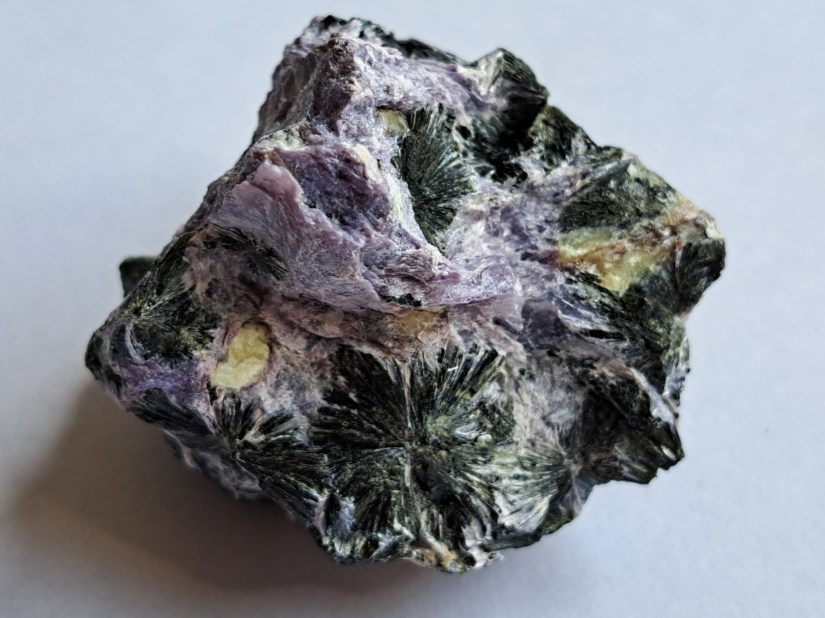
In addition to the purple waves, charoite can also contain black flecks, which are usually aegirine. There may also be yellow flecks, which can be tinaksite, canasite, or steacyite—the latter being a radioactive mineral. Charoite specimens containing this can therefore be very slightly radioactive. The radiation is barely detectable (it emits only alpha and beta radiation, not gamma radiation), but it is something to be aware of if, for example, you intend to wear it daily as a pendant.
Charoite is a mineral, but there is also a rock called charoite rock. This rock is composed primarily (more than 50%) of charoite, but also contains several other minerals, including those mentioned above, along with feldspar and quartz.
Charoite originates from the Murun Complex, Malyi Murun Massif, in East Siberia. It is found in syenite and other alkaline rocks that formed during an intrusion in the Lower Cretaceous.
Fakes & Frauds
Unfortunately, fake charoite is on the market. This consists of clay in various shades of purple, shaped into wave-like patterns. It is relatively easy to distinguish real from fake if you watch for the following features:
- The fake is quite soft and can be scratched effortlessly with a knife. Real charoite can only be scratched with great difficulty.
- The fake does not contain black or yellow inclusions.
- The fake shows no lustrous effect, and its fibrous structure is absent.
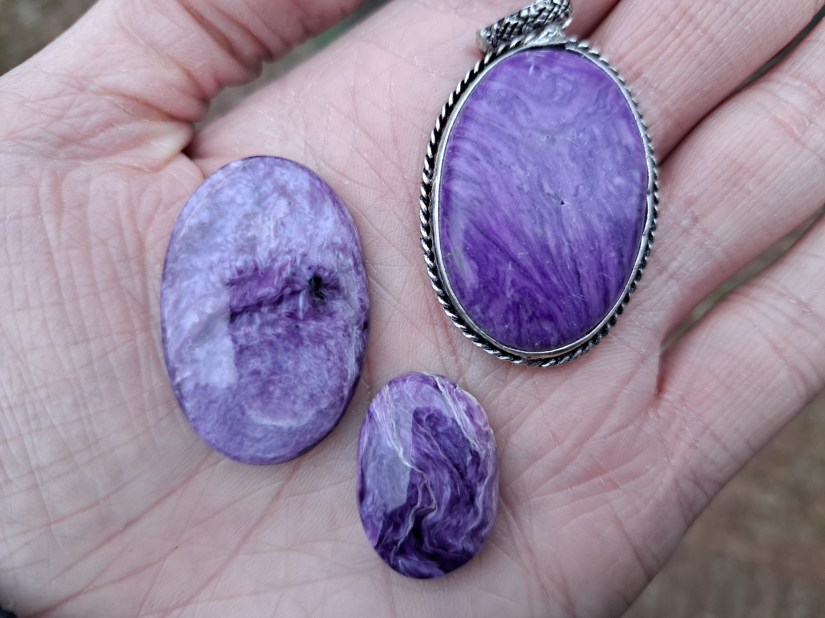
pendant
 Puffins and Pies