Chemical formula: SiO2 (Fe3+).
Mohs hardness: 7
Crystal system: Trigonal
Streak: White
Fracture: Conchoidal
Localities: Ametrine is found in only a handful of places around the world. Bolivia is the best known and has the highest quality ametrine

Amethyst and citrine?
The name ametrine is derived from a combination of the words amethyst and citrine, suggesting that it contains features of both quartz varieties. The question, however, is whether this name is truly justified and whether ametrine is indeed a genuine combination of amethyst and citrine.
There is little need for an extensive discussion about the colour of amethyst itself. The process by which amethyst acquires its characteristic purple hue is linked to the presence of iron atoms (Fe³⁺) that occupy structural positions within the quartz crystal lattice, substituting for silicon during the crystal’s growth. In addition, Fe³⁺ ions also reside in interstitial spaces within the crystal structure. When the mineral is exposed to natural ionising radiation, it takes on a purple colour as the valence state of the iron substituting for silicon changes from Fe³⁺ to Fe⁴⁺, a result of the loss of an electron due to radiation exposure. This released electron is subsequently captured by Fe³⁺ ions in the interstitial spaces, converting them to Fe²⁺. It is this interplay of charge transfer that ultimately gives amethyst its distinctive purple colour.

The origin of the colour in natural citrine is a somewhat more complex matter, and science has not yet reached a definitive conclusion regarding the exact processes responsible for it. Research indicates that small amounts of iron are present in natural citrine. However, it is generally believed that this is not the primary cause of its yellow colour.
Several observations support this hypothesis. Citrine often occurs in association with smoky quartz; its colour disappears when heated above approximately 200 °C (as is also the case with smoky quartz); and its colouration is typically much more uniformly distributed than that of amethyst, in which the colour is usually more unevenly dispersed throughout the crystal.
It is well established that smoky quartz owes its brownish colour to colour centres associated with aluminium impurities in combination with natural radiation. Aluminium is by far the most common impurity found in quartz. It is therefore highly likely that the colour of citrine arises through a similar mechanism, possibly influenced by the presence of other atoms such as hydrogen, which may also play a secondary role in the process.
When ametrine is heated to just above 200 °C, nothing remarkable occurs, the colour does not fade as it does in natural citrine. As the temperature continues to rise, the purple hue disappears first, followed by the yellow. Once the temperature exceeds approximately 400 °C, the stone becomes entirely colourless.
Experiments in which samples have been exposed to sunlight show that the purple portions gradually fade with prolonged exposure. When subjected to gamma radiation, however, the stones display little to no visible change.
It is therefore highly probable that the yellow regions of ametrine owe their colour not to the same processes that produce colour in natural citrine, but rather to the absorption and reflection of light caused by the presence of iron within the crystal structure. The yellow parts contain more iron than the purple parts.
History
Ametrine is a variety of quartz notable for its striking combination of purple and yellow colours. When it first appeared on the market in the 1970s, it was received with considerable scepticism. Many people did not believe it was a natural quartz, assuming instead that it must be either a synthetic material or a treated form of amethyst. One factor contributing to this doubt was the vague and secretive responses given when questions were asked about its origin. At that time, collecting in this region of Bolivia was prohibited, and the mine was located in a very remote area. As a result, the ametrine that was found there, illegally, was taken to Brazil. Importing gemstones from Bolivia was forbidden by the Brazilian government, so the ametrine was traded there as a Brazilian mineral.
By then, there was already considerable experience in Russia with producing two-coloured synthetic quartz, as well as with treating amethyst to turn it partially yellow through heating and irradiation. All of this combined to create widespread doubt about the authenticity of ametrine.
Geology
Mining of ametrine was finally legalised in 1989, and in the 1990s there was greater transparency regarding its origin. Scientists were now able to conduct research in Bolivia, which revealed that the stunning natural ametrine comes from the Anahí Ametrine Mine. The mine is located in the province of Santa Cruz, near the border with Brazil, at the foot of a dolomitic limestone hill that has been partially altered by hydrothermal processes. Quartz is not uncommon in the area, but the Anahí mine is the only source of high-quality ametrine. The quartz crystals are found in fissures and cracks within the rock, most likely formed by upward pressure from a hot, silica-rich solution from layers beneath the limestone. The pressure became so great that the limestone fractured abruptly, filling the cracks with the silica-rich fluid from which the ametrine grew.
The mine and its ametrine have long been known to the local population and were probably also known to Spanish conquistadors in the area. Sparse historical sources describe two-coloured quartz from this region and from Brazil. It was not until the 1970s that ametrine became widely known to the public and began to be offered as faceted gemstones. Only a small portion of the ametrine found is of sufficient quality to be cut; much of it is somewhat impure or milky. To improve its appearance, pieces are sometimes boiled in water. This can make them clearer but may also cause the material to crack.
Fakes and Frauds
As mentioned, ametrine can also be artificially produced by partially heating amethyst, and it can be synthetically manufactured, a process in which Russia has had considerable expertise since the 1950s. However, synthetic ametrine, while also two-coloured, does not display the typical six-sided pattern of natural ametrine. Its crystal faces are arranged differently, with flat, tabular growth and a diamond-shaped yellow plane at the centre of the purple areas. Synthetic ametrine often shows a more intense yellow colour than the natural variety. There are also differences in the way the boundary between the purple and yellow zones runs. In synthetic ametrine, this boundary may sometimes be slanted or curved, whereas in natural ametrine it always runs parallel to the crystal axes. Colour zoning under polarised light also differs. Brazil-law twinning in the purple region is almost always present in natural ametrine, but it is rarely seen in synthetic pieces.
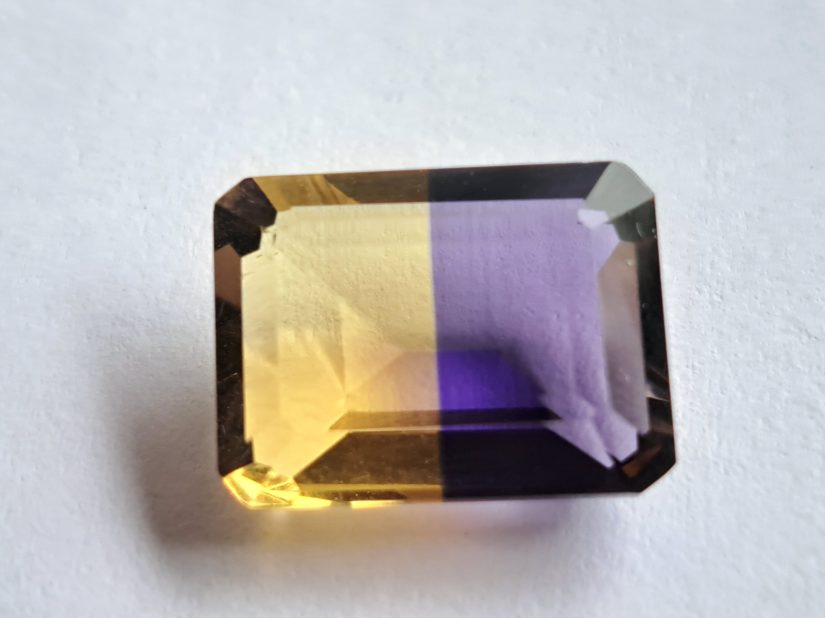
Natural amethyst can sometimes show yellow coloration caused by inclusions of oxidised iron or goethite, but this does not make it ametrine. Unfortunately, two-coloured glass or doublet glass with a man-made two-coloured base layer is also sometimes sold as ametrine.
 Puffins and Pies